Friday, January 8, 2016

Foundation of faith


"The fact that you've come this far reveals that you have it in you to succeed. 
Draw strength from the past, but don't get stuck there. Look to the future with faith, 
and remember that the seemingly small victories you collect now are 
laying the foundation of great success in the future."  
Lloyd D. Newell 


"If the foundation of faith is not embedded in our hearts, the power to endure will crumble."
 Henry B. Eyring

Thirty Gorgeous Landscape And Nature Cinemagraphs


Wednesday, January 6, 2016

All flesh is in mine hands


"All flesh is in mine hands, be still and know that I am God"

"Your peace of mind, your assurance of answers to vexing problems, your ultimate joy depend upon your trust in Heavenly Father and His Son, Jesus Christ."
Richard G. Scott

"Peace is a blessing that comes to those who trust in God. It is established through individual righteousness. True personal peace comes about through eternal vigilance and constant righteous efforts."
Marvin J. Ashton

"Let us trust the Lord, trust ourselves, and trust each other that we are trying to do the best we can. We need all the strength we can find for our daily trials. Let us not add our disapproval to another's burdens. And as we struggle with our own burdens, let us not diminish our strength by accepting the perhaps thoughtless judgments of others."
Chieko N. Okazaki

"Remove any of your fear with faith. Trust the power of God to guide you."
M. Russell Ballard

"Trust in the Lord with all thine heart; and lean not unto thine own understanding. In all thy ways acknowledge him, and he shall direct thy paths."
Proverbs 3:5-6

"Strong faith in the Savior is submissively accepting of His will and timing in our lives, even if the outcome is not what we hoped for or wanted."  David A. Bednar

Keep your chin up, trust God, and believe in good things to come. 
Jeffrey R. Holland

"Faith forged in the furnace of trials and tears is marked by trust and testimony."
Thomas S. Monson

God has a reason for allowing things to happen. 
We may never understand His wisdom but
we simply have to trust His will.

"The war goes on. It is waged across the world and in our own lives, day in and day out. We are not losing. We are winning. We will continue to win if we will be faithful and true. We can do it. We must do it. We will do it. There is nothing the Lord has asked of us that in faith we cannot accomplish. May we be faithful. May we be valiant. May we be unafraid [and] may we have the courage to be true to the trust God has placed in each of us."
Gordon B. Hinckley

Maybe He just Trusts You to do what's right.
David A. Bednar

"Rise up and follow in the footsteps of our Redeemer, and one day you will look back and be filled with eternal gratitude that you chose to trust the Atonement and its power to lift you up and give you strength."

Friday, January 1, 2016

Hope is the flame that brightens the darkest nights


The beginning of a new year is a good time to remember that most darkness is temporary. No matter how bleak or dark things may seem at times, the long nights of winter gradually grow shorter, a new day eventually dawns, and with it comes a new beginning and new confidence. Hope is the flame that brightens the darkest nights. 

During the dark days of World War II, a Jewish inmate in a Nazi concentration camp found a way to rekindle hope. It was the first night of Hanukkah (which, in most parts of the world, falls at the darkest time of the year). On this night, Jews traditionally light the first candle in their Menorah. Not having any provisions for such a celebration, the prisoner saved a scrap of bread from his meager meal and dipped it in grease from his dinner dish. After saying the appropriate prayer, he lit his makeshift candle. 

His son said to him, "Father, that was food you burned. We have so little of it. Wouldn't we have been better off eating it?" The father replied, "My son, people can live for a week without food, but they cannot live for one day without hope." 

Hope is so much more than positive thinking. It's deeper than smiley faces and lofty words, although a sincere smile or an expression of faith can be a good start. But true hope is found deep in the hearts of those who love. It is expressed through meaningful work and worthwhile activity. It is manifested in service, sacrifice, and selflessness. It leads us to see ourselves—and others—as children of a loving Heavenly Father who, as the Psalmist said, can be to us a light that casts away fear.

Each new year, and each new day, can be filled with hope and possibility. When the night seems particularly dark, let us light a candle, even if only in our hearts, to the promise of hope.

"Within us, deep down in our heart…, resides a sense of robust hope and sweet expectation that can lift us out of life's fog to see clearly who we really are. We lift the fog every time we count our blessings, every time we are kind toward others, 
every time we seriously ponder life's true purposes." 
Lloyd D. Newell

He will ever be at our side. He will fight our battles. 
He is our hope; He is our salvation; He is the way. 
Dieter F. Uchtdorf

This candle is lit in memory of my mother and my daughter Lisa.  I miss them so and do not think that time will ever heal this hurt.  DB

We build on great traditions of the past

On New Year's Day 1892, a ship of immigrants docked at Ellis Island in New York harbor. Annie Moore, a teenager from County Cork, Ireland, was the first immigrant registered at America's new reception station. She and her two younger brothers, Anthony and Phillip, had sailed in steerage class for 12 days on the steamship Nevada to join their parents, who had arrived in the United States previously. 

Over the next 62 years, 12 million people poured into this country of promise through Ellis Island. It is estimated that nearly 40 percent of American citizens today can trace their ancestry to someone who stood in line at that much-heralded entry point to a new life. 

Ellis Island no longer registers new immigrants; its main building now houses an immigration museum. Visitors to the facility can search millions of arrival records to learn about their family history. But the real history lies behind the names, dates, and birthplaces, in the actual unfolding of peoples' lives—the markers that set their course, their hopes and expectations, their joys, sorrows, disappointments, and sheer determination. 

As we learn their stories, we are better prepared to push forward to a new era. In a profound way, history enlarges the experience of daily living. In the stories of people like young Annie Moore, we see ourselves. Pulitzer Prize–winning author David McCullough, a dear friend of the Mormon Tabernacle Choir, said it this way: "History encourages, as nothing else does, a sense of proportion about life, gives us a sense of the relative scale of our own brief time on earth and how valuable that is." 

The stories of those who went before us, whether on the front page or in the footnotes, form the bedrock our lives. Whatever we may accomplish today, we build on great traditions of the past.
Heidi S. Swinton

Monday, December 28, 2015

Building up my blocks


by Emily Freeman

Today I finally finished the laundry, dusted around the fireplace, went through the stack of papers that have been piling up for months and I thought to myself, why is it that I am still trying to recover from the holidays?  There was so much good wrapped up in those endless days of celebration…but there was also so much of the unexpected. It left me a little off balance.
And that imbalance has haunted me this past few weeks, following me around, dragging at my enthusiasm for greeting each day. I will be honest, it worried me a little until I remembered a favorite quote, from a favorite author, of a favorite book.  A brilliant woman whose influence molded my life as a young mother, her whispers still carry me through…
She said, "I have this theory that everybody is born with a whole set of 'blocks' in their personalities all different colors and shapes but they each have their own individual set, and it's theirs for a lifetime.  Then, as we live, we shape those blocks into a certain pattern, and for a time that pattern is fairly stable.  Then something comes along, like adolescence, or graduation, or a mission ––some big change–– and it's as if all of our blocks get knocked down, and we have to build up our 'personhood' again.  In a sense, I guess we change, because we usually build a new pattern ––and maybe a new block comes out on top.  But we are still building with the same basic blocks.  So, in answer to your question, I don't think you've basically changed.  I just think someone has knocked down your blocks."  (Jaroldeen Edwards)
That is exactly what happened to me this month. somebody knocked down my blocks You know, somehow just knowing that made me feel better. Because I don't mind building.  I love to create.  To see something begin to take shape. But this time I am going to do things a little differently.
I am going to turn the process over to the Lord.  I'm going to let Him architect the design. I'm going to begin each day with the whisper of a prayer, "Work in me according to thy will." "Perform your good work in me…" I am going to trust Him to design a new pattern. I am going to trust Him. I woke up today to the sun and I knew right away…it was going to be a good day for building.

A collection of sunrise GIFs - Imgur

Thursday, December 24, 2015

As He loves us

As I Have Loved You
Reed Stoddard


Have you ever received a gift so wonderful that you couldn't wait to share it with someone else? The prophet Enos had such an experience when, after praying all day he finally received forgiveness of his sins. Could there be a better gift? After realizing Christ's love for him his attention then turned to a concern for the welfare of his brethren the Nephites and finally he prayed for his enemies the Lamanites. Enos had a desire to share the love of Christ that he was feeling with those around him. This pattern of coming to understand Christ's love for us and then sharing that love with others is the theme of my remarks today. 
A new commandment I give unto you, that ye love one another; as I have loved you, that ye also love one another.

By this shall all men know that ye are my disciples, if ye have love one to another.

Can you hear the tune of the primary song "As I Have Loved You" in your minds? According to the Savior himself, we become his disciples by loving others as He has loved us. I am convinced that the single element that will improve your life in general is to learn to love others as Jesus loves you. We refer to this love as charity or"the pure love of Christ."

How is it that Jesus loves us? I feel that when the Savior came upon the Earth he had three missions: the most important element of His earthly ministry was atoning for our sins and understanding our struggles, second, relieving the suffering of those around him; and third his teaching. Pure love motivated all three aspects of his mission. 

Of course, the ultimate expression of Christ's love for us is his atonement. His suffering for us and his willingness to give his life so that we can overcome the fall and our own shortcomings is his greatest example of love. Although we cannot fully comprehend the depth of His suffering, we must strive to be more familiar with and deepen our faith in the atonement. 

Some time ago I counseled a student who struggled with self-harm behavior. As I tried to understand why she felt compelled to cut herself she described to me that she felt unworthy as a person and that she felt that she needed to be punished for her unworthiness. She could not identify any specific reasons that she was unworthy; she could only convey a nebulous sense of not measuring up. This student expressed a belief in the atonement, but she felt that it didn't really apply to her. I was struck by her lack of understanding of the personal nature of the atonement of Jesus Christ. Let's turn to Alma 7:11-12:

And he shall go forth, suffering pains and afflictions and temptations of every kind; and this that the word might be fulfilled which saith he will take upon him the pains and the sicknesses of his people.

And he will take upon him death, that he may loose the bands of death which bind his people; and he will take upon him their infirmities, that his bowels may be filled with mercy, according to the flesh, that he may know according to the flesh how to succor his people according to their infirmities.
 Each of us must personalize the atonement and change our testimony from knowing that Jesus is the Savior to knowing that Jesus is my Savior. Understanding that Jesus willingly suffered for my sins, died for me, and that he experienced all my pains and all my sorrows helps me feel he loves me and he knows me and he understands me. In Lehi's dream, the tree and fruit that Lehi described as "filling him with joy" represents the love of God. The love of God is most perfectly manifested in Heavenly Father sending his son to suffer and die for us. For God so loved the world, that he gave his only begotten Son, that whosever believeth in him should not perish, but have everlasting life. The tender relief that comes with being forgiven of our sins is the essence of our Savior's love for us. Isn't it interesting that as soon as Lehi experiences the love of God by tasting the fruit, his first desire is to share that love with others? As we more fully realize the personal love involved in the atonement we should be increasingly motivated to love others more completely. We can be instruments in God's hands in bringing His love and the love of His Son to His children.

The second element of Christ's mortal ministry that exemplifies his love for us is his effort to serve. Feeding the five thousand, raising Jairus' daughter from the dead, and blessing little children are all examples of his love. He extended his love and mercy to the crippled man at the pool of Bethesda when he said "rise, take up thy bed, and walk" ; to the woman taken in adultery when he encouraged her to, "go and sin no more"; and even to his crucifiers when he begged; "Father forgive them for they know not what they do". The examples of his love and kindness go on and on.

In 1 Nephi the phrase "the tender mercies of the Lord" is used to describe Christ's on-going love for us. I believe that Christ wants to use each of us to extend his tender mercies to God's children. On the second floor of the Kimball building is a quote by Spencer W Kimball that I love. It states "God does notice us, and he watches over us. But it is usually through another person that he meets our needs. Therefore it is vital that we serve each other." Are we being that person that extends Christ's tender mercies to those we come in contact with? Similarly, Joseph B. Wirthin has stated, "Love is the very essence of the gospel of Jesus Christ. In this church, prayers for help are often answered through the simple, daily service of caring brothers and sisters. In the goodness of genuine friends, I have seen the reflected mercy of the Lord Himself."

It is humbling to consider ourselves as Jesus Christ's instruments in bringing relief to our neighbors, but what great blessing we can find in this service.

In the third element of Christ's mission, his teachings, there is a recurring theme of love. The parables of the prodigal son, the Good Samaritan, and the lost sheep and, wisdom like "in as much as you have done it unto the least of these my brethren, ye have done it unto me", are just a few of His well known teachings on the importance of loving others. When Jesus was asked which was the greatest commandment, he gave the familiar response that is found in Matthew 22: 37-40:

Jesus said unto them, Thou shalt love the lord thy God with all thy heart, and with all thy soul, and with all thy mind.

This is the first and great commandment.

And the second is like unto it, Thou shalt love thy neighbor as thyself.

On these two commandments hang all the law and the prophets.

Did you notice that both of these two greatest commandments begin the same; "thou shalt love?" Neal A Maxwell said that developing love for others is essential to obtaining eternal life."Developing charity is clearly just as essential for admission to the upper realms of the Celestial kingdom as is baptism. We are to be more than merely nice, rather we are to be 'full of love'."

Perhaps you are like me and find commandments that demand more attention to the letter of the law easier to follow than ones that require more focus on the spirit of the law (such as possessing charity). My grandfather struggled with the Word or Wisdom. He could not seem to give up his morning cup of coffee. But Grandpa was one of the most charitable, service-oriented people I have ever known. Sometimes I am afraid I will fall into a false sense of security by thinking "I'm doing OK, I am living the commandments" because I am following the more straight forward laws but overlook the importance of more enigmatic laws like loving my neighbor. 

Besides my grandfather, I have had many wonderful examples of loving as Jesus loves in my life. My father died when I was a young boy. Through my early years, other men stepped in to provide love and examples to help compensate for the loss of my father. I think of Bishop Aaron Angel, a small man in physical stature but a giant to me, as he extended love and thoughtfulness to me as an awkward teenager. Another was a great young men's leader and home teaching companion, Wayne Parkinson. At first we young men all looked up to Wayne because he had a cool car and a beautiful wife, but gradually I looked up to Wayne because I knew that he cared about me and took time out of his busy life for me. I also had an older college roommate when I attended here who extended love to me as a pre-missionary. Brad would wake me up so that I could get to our priesthood meeting that started early each Sunday. I regret that I wasn't always appreciative of Brad's efforts at the time, but I look back on his efforts with a grateful heart. Some of these efforts may seem minor to you; but they made a difference in my life then and inspire me still to look for opportunities to serve others. Of course the most profound example of love in my life, short of the Savior himself, has been my dear wife DeeAnn, who loves me so selflessly and unconditionally. 

We know that we are to love others, but too often our behavior may actually be a reflection of a more Cain-like attitude of "am I my brother's keeper?" Some obstacles that I am aware of in my own life that keep me from being more charitable are: a selfish attitude, being distracted by worldly cares, a judgmental disposition and, fear. Perhaps you can relate to some of these weaknesses.

If we are not careful our own priorities and issues, though worthwhile, may blind us from opportunities to reach out to others. Someone once said that the enemy of the best is the good. We can spend our life doing good and still not be the instrument that Heavenly Father intended us to be.

A classic experiment in social psychology conducted at the Princeton Theological Seminary in the early 70's illustrates the natural tendency to choose selfish priorities over others' urgent needs. Seminary students were to prepare a sermon on the "Good Samaritan" and then told to go to another building on campus to have their sermon recorded. Unbeknownst to the seminary students, a man was placed on the route between the two buildings, slumping in a door-way—looking to be in obvious need of help. What would you guess was the crucial variable that predicted how likely a seminary student, ready to preach about the "Good Samaritan" was to stop and help a person in distress? The deciding variable was neither their age, nor how "religious" the student was, as rated by classmates. Instead it was how much of a hurry the student was in. The students had been divided into three categories. The first group was told they were late for the recording session and would need to hurry to make it. The second group was told they had just enough time to make the recording session; and the third group was told that they had a few moments to spare. The study found that the students who had time to spare were most likely to help the man in distress. Of those in a hurry, only 10% stopped to help the man in need. Those who were hurrying to make their recording session were 6 times less likely to stop and help. Even with the lesson of the Good Samaritan freshly on their minds, the students were in too much of a rush to help someone in need. Sadly, I'm not sure I would do much better in those circumstances. 

President Hinckley addressed this dilemma of making time for others in a devotional speech to BYU students in 1995:

I know that you are engrossed with your studies. This is important, but in a sense it is a selfish pursuit. Take a little time, now and again, to reach out beyond yourselves to help others. There are those around you, students in need of a little kindness, a little attention, a little appreciation. My dear young friends, give expression to the noble desires that lie within your hearts to reach out to comfort, sustain and build others. As you do so, the cankering poison of selfishness will leave you, and it will be replaced by a sweet and wonderful feeling that comes in no other way.

Selfishness is the opposite of charity and must be eliminated if we are to develop true Christ-like love. Neal A. Maxwell has counseled:

So often what people need so much is to be sheltered from the storms of life in the sanctuary of belonging. Such a service cannot be rendered by selfish people, however, because the response of the selfish will always be that there is no room in the inn. Chronic self-concern means that the "No Vacancy" sign is always posted. Frequently we busily search for group service projects, which are surely needed and commendable, when quiet, personal service is also urgently needed. Sometimes the completing of an occasional group service project ironically salves our consciences when, in fact, we are constantly surrounded by a multitude of opportunities for individual service. In serving, as in true worship, we need to do some things together and some things personally.

Reaching out to others can put us in a vulnerable position. What if our attempts to be kind or helpful are rejected? When we fear rejection, we might take courage by looking to the Savior, whose mercy is often not accepted, and yet he "stands at the door and knocks" ready to love those who will receive Him. Mormon knew the antidote to fear as he tells us: "I fear not what man can do because perfect love casteth out all fear" (Moroni 8:16).

Another stumbling block to the development of charity can be a judgmental attitude. We may feel that the person has brought upon themselves their difficulties, or we may feel that they are not deserving of our compassion. King Benjamin warns against such judgments in Mosiah 4:17-19:

Perhaps thou shalt say: The man has brought upon himself his misery; therefore I will stay my hand, and will not give unto him of my food, nor impart unto him of my substance that he may not suffer, for his punishments are just-

But I say unto you, O man, whosoever doeth this the same hath great cause to repent; and except he repenteth of that which he hath done he perisheth forever, and hath no interest in the kingdom of God.

For behold are we not all beggars?

As we overcome some of these natural-man tendencies that blunt our development of charity, and as we endeavor to be more loving, we will be blessed with improved spirituality and an increased capacity to love. Elder Cuthbert has stated:

Over the years many people, especially youth, have asked me, 'Elder Cuthbert, how can I become more spiritual?' My reply has always been the same: "You need to do more service." Service changes people. It refines, purifies, gives a finer perspective, and brings out the best in each one of us. It gets us looking outward instead of inward. It prompts us to consider others' needs ahead of our own. Righteous service is the expression of true charity, such as the Savior showed.

In addition to overcoming these obstacles to charity, we might be more loving by considering at least the three following emphases:

First of all, we can focus more on the atonement. Once again, Enos was an example of a strong desire to understand the atonement. He described his desire as a "wrestle … before God", and he said that his father's teachings "sunk deep into my heart", and that his "soul hungered". Even after being forgiven he wondered "Lord, how is it done?". What a great model for us to follow in striving to make the atonement more real in our lives. Could similar words describe our search for a deeper understanding of the atonement? I know that I could make better use of things that we have already been provided to help us to "always remember him." The weekly ordinance of the Sacrament is designed to help us remember Christ's sacrifice. My use of that reverent time could greatly be improved. We could also improve our focus on the scriptures, which are designed to testify and instruct regarding the Savior. In Lehi's dream it was the iron rod, which represents the word of God that led Lehi to the tree and fruit which represent God's love. Studying the scriptures and the teachings of modern day prophets will help bring us to Christ. The reason that we refer to the Book of Mormon as another testament of Jesus Christ is that if we read it with real intent it can bring us closer to Christ and to an understanding of His love for us. Worshipping more regularly in the temple also helps us focus more on the atonement. I need to take more time to ponder the love Jesus has for me and for my brothers and sisters.

Secondly, we can reflect on the service and love that we have received from others and be inspired to reach out to those around us. I remember as a youth getting a phone call before school on my 17th birthday from Bishop Angell. The conversation was very brief, but I still recall being impressed that he would think to call me and wish me a happy birthday. I am trying to repeat that thoughtfulness as a bishop now, almost 30 years later.

Finally, charity is a gift from God that we must earnestly seek after. We should pray that we will be aware of those who could use our help and we can pray for the courage to act in those situations. Let us follow Mormon's admonition in Moroni 7:48, "Pray unto the Father with all the energy of heart, that we may be filled with this love, which he hath bestowed upo

I love the sweet, simple way that our hymns teach us doctrine. A favorite of mine is Lord I Would Follow Thee:

Savior, may I learn to love thee,
Walk the path that thou hast shown,
Pause to help and lift another,
Finding strength beyond my own.

Who am I to judge another
When I walk imperfectly?
In the quiet heart is hidden
Sorrow that the eye can't see.

I would be my brother's keeper;
I would learn the healer's art.
To the wounded and the weary
I would show a gentle heart.

Savior, may I love my brother
As I know thou lovest me,
Find in thee my strength, my beacon
For thy servant I would be.

Lord, I would follow thee.

As we work on loving others, we feel our Savior's love more completely. He stands ready to bless us if we will take action.

In October, at President Clark's inauguration President Hinckley made a prediction about the potential for the environment at BYU–Idaho. He said:

I submit that this campus, with its adjoining buildings, may literally offer a foretaste of heaven with the imparting of knowledge, both secular and spiritual, with the encouragement of unselfish service, with the teaching of values that are everlasting in their consequences, and with faith in the living God. I pray that it may be so.

What a wonderful promise. Increased charity would not only create a "foretaste of heaven" at BYU–Idaho, but also throughout the world as you take your willingness to love with you and as you continue to bless the lives of people wherever you are. Let's each renew our efforts to better understand our Savior's love and to overcome the weaknesses that keep us from more fully loving others as He loves us.

I testify of the truthfulness of the atonement of Jesus Christ. He is my Savior. I am grateful for His love in my life. It is the greatest gift that any of us could ever receive. May we each strive to be more charitable, by loving others as Jesus loves us, I pray in the name of Jesus Christ, amen.
 

Wednesday, December 23, 2015

He restores. He leads. He encourages.


The difference between stumbling blocks and stepping stones is how you use them. ~Unknown
David Butler
Isn't it funny how quickly a conversation hops topics. One minute baseball, the next the moon. Sometimes, in the right place, at the right times, those conversations settle somewhere deeper–I love those times. Yesterday we were there–in those deeper places–some friends and I. As we were talking we hit a stumbling block.  A question that made us all wonder. Sometimes in those moments, bewilderment can accidentally turn into doubt. Faith seems to grow slowly and deliberately–like a gorgeous and grand oak–but doubt seems to spread like a weed. I feel danger when it lingers. And then a friend said something so penetrating.
As I hummed and hawed about the solution to the dilemma that was presented, he said simply: "I don't know.  But it must be for good, because God is so good." It must be for good…because God is so good. Why would it be any other way? Yes, I believe he is right. God, who is so very very good, would not orchestrate something that didn't have the most brilliant of purposes and reasoning.
Purposes that would elevate and refine and beautify his children. When you can't see the hand of God–you trust His heart. He is our shepherd and would never leave us wanting. He offers green pastures–places of safety–and still waters–places of refreshment. He restores.  He leads.  He encourages.  Ever beside me. He fills my empty cup to overflowing.
"Surely goodness and mercy shall follow me all the days of my life…" (Psalm 23)  Surely. Surely there's a good and merciful reason. Because of who He is.

Take his hand


The Gift by Ericseye on deviantART

Prepare the way


A beacon of light.


Hear him


Tuesday, December 22, 2015

Not a pastime


"This life is not given to us as a pastime. There was a solemn purpose in our creation, in the life that God has given to us. Let us study what that purpose is, that we may progress and obtain eternal life"  
George Albert Smith

sunset through the forest!


Monday, December 21, 2015

A spiritual gift from God

change

"There is nothing so unchanging, so inevitable as change itself… There is a constant that allows us to use change for our own good, and that constant is the revealed eternal truths of our Heavenly Father."   Marvin J. Ashton

The power to change is very real, and it is a great spiritual gift from God. 
Each new day that dawns can be a new day for us to begin to change. We can change our environment. We can change our lives by substituting new habits for old. We can mold our character and future by purer thoughts and nobler actions. As someone once put it, "The possibility of change is always there, with its hidden promise of peace, happiness, and a better way of life."
James E. Faust

"Every mighty change of heart matters to the Lord. And it will make all the difference to you."  
Jean A. Stevens

"Something wonderful happens when we really know, without a doubt, that God loves us—our questions completely change. Instead of asking, 'Why did this happen to me?' or 'Why doesn't God care about me?' we say, 'Well, I know God loves me; I know that. So what can I learn from this experience?'"  
John Bytheway

You have to remember, fear is not real. It is a product of the thoughts you create. Don't misunderstand me. Danger is very real, but fear is a choice.

Heavenly Father loves you


Saturday, December 19, 2015

A Witness of the Savior Jesus Christ

By President Boyd K. Packer (1924–2015)

During his 54 years as a General Authority and his 45 years as an Apostle, a special witness “of the name of Christ in all the world” (D&C 107:23), President Packer humbly bore testimony. Shortly before his death on July 3, 2015, President Packer requested that the following excerpts from his ministry be shared in theLiahona. In the spirit of the Christmas season, they highlight his witness of and love for the Savior Jesus Christ.
Christ and the Young Child
Detail from Christ and the Young Child, by Carl Heinrich Bloch

I Love the Lord

“I love Christmas. There is a spirit at Christmastime. It descends upon the world—not just to members of the Church but across the world—a testimony and a witness that Jesus is the Christ. … As a servant of the Lord, as one of the Twelve, I know that Jesus is the Christ. …
“I love the Lord. I love His work. I love The Church ofJesus Christ of Latter-day Saints and bear witness of Him who is our Master and our Friend.”1

Of Him I Am a Witness

“There are some things just too sacred to discuss. …
“It is not that they are secret, but they are sacred; not to be discussed, but to be harbored and to be protected and regarded with the deepest of reverence.
“I have come to know what the prophet Alma meant:
“‘… It is given unto many to know the mysteries of God; nevertheless they are laid under a strict command that they shall not impart only according to the portion of his word which he doth grant unto the children of men, according to the heed and diligence which they give unto him.
“‘And therefore, he that will harden his heart, the same receiveth the lesser portion of the word; and he that will not harden his heart, to him is given the greater portion of the word, until it is given unto him to know the mysteries of God until he know them in full’ (Alma 12:9–10). …
“Now, I wonder with you why one such as I should be called to the holy apostleship. There are so many qualifications that I lack. There is so much in my effort to serve that is wanting. As I have pondered on it, I have come to only one single thing, one qualification in which there may be cause, and that is, I have that witness.
“I declare to you that I know that Jesus is the Christ. I know that He lives. He was born in the meridian of time. He taught His gospel, was tried, was crucified. He rose on the third day. He was the first fruits of theresurrection. He has a body of flesh and bone. Of this I bear testimony. Of Him I am a witness.”2

He Accepted the Penalty

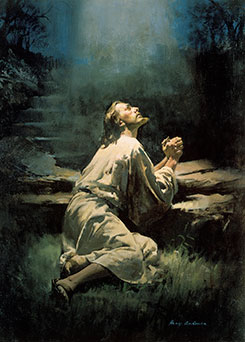
Not My Will, But Thine, Be Done
Not My Will, But Thine, Be Done, by Harry Anderson, courtesy of Pacific Press Publishing Association, Inc., may not be copied
“Before the Crucifixion and afterward, many men have willingly given their lives in selfless acts of heroism. But none faced what Christ endured. Upon Him was the burden of all human transgression, all human guilt. And hanging in the balance was the Atonement. Through His willing act, mercy and justice could be reconciled, eternal law sustained, and that mediation achieved without which mortal man could not be redeemed.
“He by choice accepted the penalty in behalf of all mankind for the sum total of all wickedness and depravity; for brutality, immorality, perversion, and corruption; for addiction; for the killings and torture and terror—for all of it that ever had been or all that ever would be enacted upon this earth. In so choosing He faced the awesome power of the evil one, who was not confined to flesh nor subject to mortal pain. That was Gethsemane!
“How the Atonement was wrought we do not know. No mortal watched as evil turned away and hid in shame before the Light of that pure being. All wickedness could not quench that Light. When what was done was done, the ransom had been paid. Both death and hell forsook their claim on all who would repent. Men at last were free. Then every soul who ever lived could choose to touch that Light and be redeemed.
“By this infinite sacrifice, ‘through [this] Atonement of Christ, all mankind may be saved, by obedience to the laws and ordinances of the Gospel’ (Articles of Faith 1:3).”3

The Master Teacher

“In the course of my efforts to teach His gospel, I have come to know Him, Jesus Christ, the Son of God, the Only Begotten of the Father. I stand in reverence before Him with deep regard for what He taught, and with deep regard for how He taught. It is not untoward for any of us to aspire to teach as He taught. It is not untoward for any of us to aspire to be like Him. He was not just a teacher; He was the master teacher.”4

The Truth Most Worth Knowing

“As mortals, we may not, indeed cannot, understand fully how the Savior fulfilled His atoning sacrifice. But for now the how is not as important as the why of His suffering. Why did He do it for you, for me, for all of humanity? He did it for the love of God the Father and all mankind. ‘Greater love hath no man than this, that a man lay down his life for his friends’ (John 15:13).
“In Gethsemane, Christ went apart from His Apostles to pray. Whatever transpired is beyond our power to know! But we do know that He completed the Atonement. He was willing to take upon Himself the mistakes, the sins and guilt, the doubts and fears of all the world. He suffered for us so that we would not have to suffer. Many mortals have suffered torment and died a painful, terrible death. But His agony surpassed them all. …
“His suffering was different than all other suffering before or since because He took upon Himself all of the penalties that [could ever be] imposed on the humanfamily. Imagine that! He had no debt to pay. He had committed no wrong. Nevertheless, an accumulation of all of the guilt, the grief and sorrow, the pain and humiliation, all of the mental, emotional, and physical torments known to man—He experienced them all. There has been only One in all the annals of human history who was entirely sinless, qualified to answer for the sins and transgressions of all mankind and survive the pain that accompanied paying for them.
“He presented His life and in essence said, ‘It is I that taketh upon me the sins of the world’ (Mosiah 26:23). He was crucified; He died. They could not take His life from Him. He consented to die. …
“If you have stumbled or even been lost for a time, if you feel that the adversary now holds you captive, you can move forward with faith and not wander to and fro in the world any longer. There are those who stand ready to guide you back to peace and security. Even the grace of God, as promised in the scriptures, comes ‘after all we can do’ (2 Nephi 25:23). The possibility of this, to me, is the truth most worth knowing.
“I promise that the brilliant morning of forgiveness can come. Then ‘the peace of God, which passeth all understanding’ (Philippians 4:7) comes into your life once again, something like a sunrise, and you and He ‘will remember [your] sin no more’ (Jeremiah 31:34). How will you know? You will know! (See Mosiah 4:1–3.)”5

My Witness

“After all the years that I have lived and taught and served, after the millions of miles I have traveled around the world, with all that I have experienced, there is one great truth that I would share. That is my witness of the Savior Jesus Christ.
“Joseph Smith and Sidney Rigdon recorded the following after a sacred experience:
“‘And now, after the many testimonies which have been given of him, this is the testimony, last of all, which we give of him: That he lives!
“‘For we saw him’ (D&C 76:22–23).
“Their words are my words.”6
“How privileged I have been throughout my life to be able to bear my special witness that Jesus is the Christ, the Son of God. I testify in all humility, but with absolute certainty, that He is the Only Begotten of the Father. This is His Church; He presides over it and directs this work. He is our Redeemer. I know He lives, and I know Him. Of this I testify in the name of Jesus Christ, amen.”7

Friday, December 18, 2015

Walk not in darkness

"The best paths in life are rarely the easiest."
Carlos A. Godoy

His mission, His ministry among men, His teachings of truth, His acts of mercy, His unwavering love for us prompts our gratitude and warms our hearts. Jesus Christ, Savior of the world-even the Son of God-was and is the ultimate pioneer, for He has gone before, showing all others the way to follow.
May we ever follow Him. 
Thomas S. Monson

With the pure love of Christ, let us walk in His footsteps as we approach the season celebrating His birth. As we do so, let us remember that He still lives and continues to be the Light of the World, who promised, "He that followeth me shall not walk in darkness, but shall have the light of life. 
Thomas S. M
onson

"An interesting thing happens whenever you attempt to place your feet in Christ's footsteps. If you really concentrate on trying to walk the way He walked—loving, caring, serving, and obeying each step of the way—one day you'll look up and discover that His path has led you directly to the throne of God. For that is and ever has been His great purpose and mission: to lead us to our Heavenly Father."
 M. Russell Ballard

Matthew 19:23–26, Christ teaches John and the other Apostles